
Archive for undergraduates
oops there it goes again
Posted in Kids, pictures, Statistics, University life with tags amazon associates, Cauchy-Schwarz inequality, Cramer-Rao lower bound, customer service, drawing tablet, drivers, Huion, teaching, undergraduates on February 16, 2024 by xi'an
last exams
Posted in Kids, Statistics, University life with tags #ERCSyG, academia, bilingual training, chores, European Research Council, final exam, lexicon, mathematical statistics, PSL Research University, statistics courses, teaching statistics, undergraduates, Université Paris Dauphine on January 19, 2024 by xi'an
Pisa leans even further
Posted in Books, Kids with tags curriculum, high school, high school mathematics, inconsistency, Le Monde, OECD, PISA, reformation, undergraduates, Université Paris Dauphine on December 24, 2023 by xi'an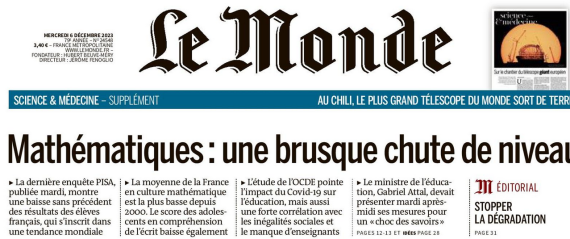

Monte Carlo swindles
Posted in Statistics with tags Basu's theorem, exam, John Tukey, Monte Carlo approximations, Monte Carlo swindle, Rao-Blackwell theorem, Rao-Blackwellisation, teaching, The American Statistician, undergraduates on April 2, 2023 by xi'an While reading Boos and Hugues-Olivier’s 1998 American Statistician paper on the applications of Basu’s theorem I can across the notion of Monte Carlo swindles. Where a reduced variance can be achieved without the corresponding increase in Monte Carlo budget. For instance, approximating the variance of the median statistic Μ for a Normal location family can be sped up by considering that

by Basu’s theorem. However, when reading the originating 1973 paper by Gross (although the notion is presumably due to Tukey), the argument boils down to Rao-Blackwellisation (without the Rao-Blackwell theorem being mentioned). The related 1985 American Statistician paper by Johnstone and Velleman exploits a latent variable representation. It also makes the connection with the control variate approach, noticing the appeal of using the score function as a (standard) control and (unusual) swindle, since its expectation is zero. I am surprised at uncovering this notion only now… Possibly because the method only applies in special settings.
A side remark from the same 1998 paper, namely that the enticing decomposition
![\mathbb E[(X/Y)^k] = \mathbb E[X^k] \big/ \mathbb E[Y^k]](https://s0.wp.com/latex.php?latex=%5Cmathbb+E%5B%28X%2FY%29%5Ek%5D+%3D+%5Cmathbb+E%5BX%5Ek%5D+%5Cbig%2F+%5Cmathbb+E%5BY%5Ek%5D&bg=000000&fg=B0B0B0&s=0&c=20201002)
when X/Y and Y are independent, should be kept out of reach from my undergraduates at all costs, as they would quickly get rid of the assumption!!!
deGPTed
Posted in Books, Kids, Statistics, University life with tags chatbots, exponential families, mathematical statistics, OpenAI, Stack Exchange, undergraduates on December 20, 2022 by xi'an
As shown above, automated chatbots are becoming a nuisance on fori such as Stack Exchange. To illustrate the nuisance capacity, here is a question / answer I produced there:

It sounds completely correct except for the core issue of not explaining why the Uniform density is not expressible as an exponential… And the answer is exactly the same when substituting Gamma for Uniform!


 Xi'an's Og