
Archive for book reviews
maths as catchy background [and no further future for humanity]
Posted in Books, pictures, University life with tags AI, artificial intelligence, book reviews, dystopia, mathematical formula, neural networks and learning machines, Nick Bostrom, Philosophy of Science, poor maths, superintelligence, The Guardian, University of Oxford on May 11, 2024 by xi'an
the flawed genius of William Playfair [book review]
Posted in Books, pictures, Statistics, University life with tags 1789, Abraham De Moivre, Adam Smith, bankruptcy, Birmingham, book reviews, capitalism, code breaking, counterfeit, Edinburgh, Edrward Gibbons, Elba, encryption, England, English politics, French Revolution, industrial revolution, Jacobin, Jonathan Strange & Mr Norrell, London, Malthus, Napoléon Bonaparte, Neufchâtel, Paris, Richard Price, Scotland, spy novels, statistical graphics, Thomas Bayes, University of Toronto, Whigs, WIlliam Pitt, William Playfair on March 26, 2024 by xi'an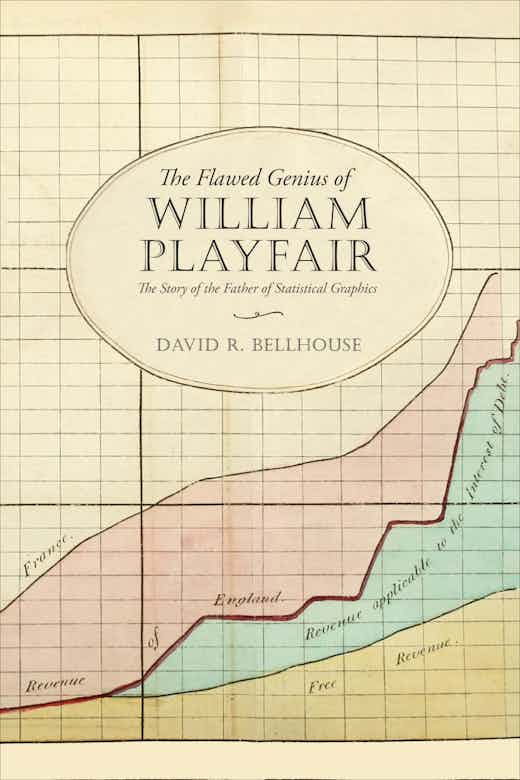 David Bellhouse has written a new book on the history of statistics, focussing on William Playfair this time (following his fantastic book on Abraham de Moivre). The Flawed Genius of William Playfair (The Story of the Father of Statistical Graphics) got published a few months ago by the University of Toronto Press.
“[Playfair] was an ideas man whose ideas often did not come to fruition; or, when they did, they withered or exploded.” [p.121]
The impressions I retained from reading this detailed account of a perfect unknown (for me) are of a rather unpleasant, unappealing, unsuccessful, fame-seeking, inefficient, short-sighted, self-aggrandising, bigoted, dishonest, man, running from debtors for most of his life, with jail episodes for bankruptcy, while trying to make a living from all sorts of doomed enterprises, short-lived blackmailing attempts, and mediocre books that did not sell to many. Similar to David Bellhouse’s colleague earlier wondering at the appeal of exposing such a rogue character, I am left with this lingering interrogation after finishing the book…
“[Richard] Price liked what Playfair had written. He found [in 1786] Playfair to be “agreeable” and “useful”.” [p.64]
Not that I did not enjoy reading it!, as it gives a most interesting of the era between the 18th and the 19th Centuries, in particular in its detailed narration of the first months of the French Revolution of 1789, and of the impact of the Industrial Revolution on economics and politics as the birth of capitalism. The book abounds in crossing lots of historical characters, like Richard Price (Bayes’s friend who published his most famous paper), Adam Smith (whose book Playfair reprinted with poor additions), Edward Gibbons (whose book along with Smith’s inspired the title of his Inquiry Into the Permanent Causes of the Decline and Fall of Powerful and Wealthy Nations), Thomas Malthus (competing for an annotated edition of Smith’s book), not to mention the political class of Britain at the time. David Bellhouse’s book demonstrates academic and historical excellence, constantly being very detailed, with a wealth of references, documents, and definite support for or against the rumours that accompany the life and deeds of Playfair. (Frankly, rarely a name has been that inappropriate!) This includes for instance the pictures pointing out to his first (?) forged signature [p.140] and the evacuation of the myth of Playfair as a spy for the British Crown—which the Wikipedia page happily reproduces, pointing out the need for an in-depth revision of said page. Similarly, the book delivered a convincing discussion of arguments for and mostly against Playfair “being the key player in the British operation to forge [French] assignats” towards destroying its economy. A lot of the book is touching upon the then novel issue of paper money, which Playfair only and negatively considered through his own (and catastrophic) experiences. At times, the book is almost too scholarly as it makes reading less fluid than was the case his Abraham de Moivre for instance. (And obviously less than in the contemporary Jonathan Strange & Mr. Norrel!) 
It may be that my very relative lack of enthusiasm stems from the realisation that the story of Playfair is overall rather little connected with statistical inference, if not with descriptive statistics (albeit with a complete disregard for the quality and sources of his data), as when publishing a Statistical Breviary on descriptive statistics for a series of countries (and surprisingly sold on Amazon!). Or Statistical Account of the United States of America. And of course for his innovative graphical representations like the one represented on the cover of the book or the pie chart. I feel that the book is much more engaged in Playfair’s contributions to the then nascent science of economics, as for instant about the shallow and mostly misguided views of his’ on banking and running the economy, while conducting his personal finance and investments so disastrously that it negatively advertised against confidence in such views.
On a very personal level, I noticed that some graphs were provided by my friend and statistics historian Stephen Stigler [who also wrote a review of the book] while an analysis of the poor French involved in a coding scam of Playfair about Napoléon’s escape from Elba was by Christian Genest (whom I first met at a statistics conference dinner on the Lac de Neufchâtel in 1986).
[Disclaimer about potential self-plagiarism: this post or an edited version will eventually appear in my Books Review section in CHANCE. As appropriate for a book about Chance!]
Hugo[red] Awards 2023
Posted in Books, Kids, Travel with tags Adrian Tchaikovsky, amazon associates, Ben Aaronovitch, book reviews, censorship, China, Communist Party of China, dictature, fantasy, Hugo Awards, science fiction, worldcon on February 23, 2024 by xi'an

Here are the 2023 awards [connected to my read & to-read lists]. As the votes were made by participants to the 2023 Chengdu Worldcon, Chengdu, China, censorship later came to light, regarding authors critical of the Chinese government, like Kuang, Zhao, and Gaiman, who did not make it to the shortlist…
Best Novel
- Nettle & Bone, by T. Kingfisher (Tor Books) [to read]
- The Kaiju Preservation Society, by John Scalzi (Tor Books) [to read]
- Legends & Lattes, by Travis Baldree (Tor Books)
- Nona the Ninth, by Tamsyn Muir (Tordotcom) [not read yet, as the amazonly supported book sits at a friend’s place in the US!]
- The Spare Man, by Mary Robinette Kowal (Tor Books)
Best Novella
- Where the Drowned Girls Go, by Seanan McGuire (Tordotcom) [to read]
- Ogres, by Adrian Tchaikovsky (Solaris) [to read]
- What Moves the Dead, by T. Kingfisher (Tor Nightfire) [to read]
Best Series
- Children of Time Series, by Adrian Tchaikovsky (Pan Macmillan/Orbit) [1/3 read]
- The Locked Tomb, by Tamsyn Muir (Tor.com) [2/3 read]
- Rivers of London, by Ben Aaronovitch (Orion) [read]
- The Scholomance, by Naomi Novik (Del Rey) [2/3 read]
Best Dramatic Presentation, Long Form
- Everything Everywhere All at Once, screenplay by Daniel Kwan and Daniel Scheinert, directed by Daniel Kwan and Daniel Sheinert (IAC Films / Gozie AGBO) [watched]
a second course in probability² [book review]
Posted in Books, Kids, Statistics, University life with tags book reviews, Cambridge University Press, central limit theorem, CHANCE, conditional probability, cross validated, cup, dominated convergence, introductory textbooks, Lebesgue integration, Markov chains, martingales, measure theory, minorisation, renewal process, Riemann integration on December 17, 2023 by xi'an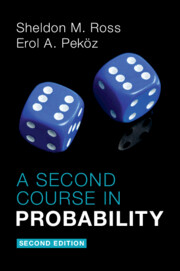 I was sent [by CUP] Ross & Peköz Second Course in Probablity for review. Although it was published in 2003, a second edition has come out this year. I had not looked at the earlier edition hence will not comment on the differences, but rather reflect on my linear reading of the book and my reactions as a potential teacher (even though I have not taught measure theory for decades, being a low priority candidate in an applied math department). As a general perspective, I think it would be deemed as too informal for our 3rd year students in Paris Dauphine.
This indeed is a soft introduction to measure based probability theory. With plenty of relatively basic examples as the requirement on the calculus background of the readers is quite limited. Surprising appearance of an integral in the expectation section before it is ever defined (meaning it is a Riemann integral as confirmed on the next page), but all integrals in the book will be Riemann integrals, with hardly a mention of a more general concept or even of Lebesgue integration (p 16). Which leads to the probability density being defined in terms of the Lebesgue measure (not yet mentioned). Expectation as suprema of step functions which is enough to derive the dominated convergence theorem. And a (insufficiently detailed?) proof that inverting the cdf at a uniform produces a generation from that distribution. Representation that proves most useful for the results of convergence in distribution. Although the choice (p 31) that all rv’s in a sequence are deterministic transforms of the same Uniform may prove challenging for the students (despite mentioning Skohorod’s representation theorem). Concluding the first chapter with an ergodic theorem for stationary and… ergodic sequences, possibly making the result sound circular. Annoyingly (?) a lot of examples involve discrete rvs, the more as we proceed through the chapters. (Hence the unimaginative dice cover.)
Chap 2, the definition of stochastically smaller is missing italics on the term. This chapter relies on the powerful notion of coupling, leading to Le Cam’s theorem and the Stein-Chen method. Declined for Poisson, Geometric, Normal, and Exponential variates, incl. a Central Limit Theorem. Surprising appearance of a conditional distribution and even more of a conditional variate (Theorem 2.11) that I would criticize as sloppy were it to occur within an X validated question!
Chap 3 on martingales with another informal start on conditional expectations using some intuition from the easiest cases, but also a yet undefined notion of conditional distribution. The main application of the notion is the martingale stopping theorem, with mostly discrete illustrations. (The first sentence of the chapter is puzzling, presenting as a generalisation of iid-ness a sequence of rv’s as having each term depending on the previous ones when the joint distribution can always be decomposed this way by a towering argument.)
Chap 4 on probability bounds with a first technique using the importance sampling identity, which includes the Chernoff bound as a special case. While there are principles at work, I am always uncomfortable teaching about these inequalities, as it often relies on a clever trick.
 Chap 5 on Markov chains (with Markov deserving of an historical note contrary to Stein or Le Cam, Borel or Cantelli which would have helped my student seeking their names!) but this is solely done on discrete state spaces, without a mention that irreducible transient Markov chains cannot occur on a finite state space. The chapter covers essentials in that context, including Gambler’s ruin, but I’d rather refer to Feller’s (1970) more general coverage and wonder why the authors stuck to the discrete case.
Chap 6 on renewal theory, albeit defined only for crossing renewal times. In the spirit of Meyn & Tweedie (1994), I find renewal times quite useful in establishing Central Limit theorems in non-iid sequences, but here it is only applied to the renewal process itself (with a typo in Proposition 6.7). The chapter however includes an example of forward exact sampling for a Markov chain satisfying a minorisation condition, as well as brief sections on queuing and Poisson processes.
Chap 7 on Brownian motion, no less! With a discrete iterative construction one hopes will conduct to a proper limit as its existence is not formally proven. And which I deem did not require five figures to explain how to randomly move the midpoint of a segment. This short and final chapter proceeds à marche forcée towards a Central Limit theorem for general stationary and ergodic random variables. A bit too much for a 180p book.
[Disclaimer about potential self-plagiarism: this post or an edited version will eventually appear in my Books Review section in CHANCE.]
A. K. Md. Ehsanes Saleh (01 Jan 1932 – 03 Sept 2023)
Posted in Books, Statistics, Travel, University life with tags A. K. Md. Ehsanes Saleh, Bangladesh, book reviews, Canada, Carleton University, Cornell University, James-Stein estimator, obituary, Ottawa, Purdue University, ridge regression, SFDS, shrinkage estimation, SSC, West Lafayette on December 10, 2023 by xi'an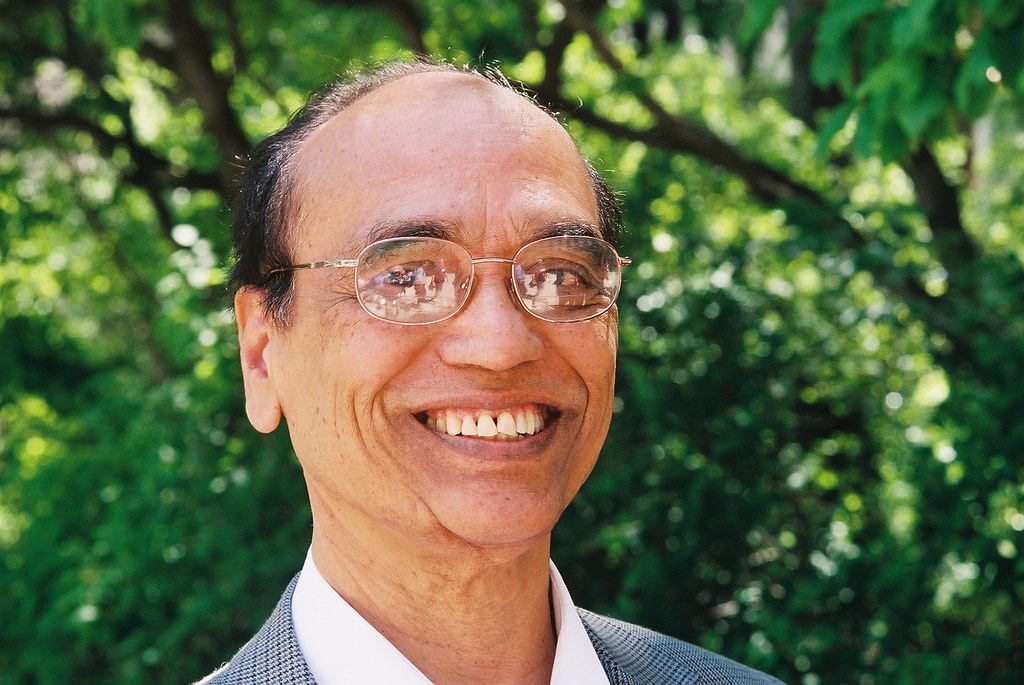 Just learned this day that Professor A. K. Md. Ehsanes Saleh passed away in early September. I first met him sometimes in the Fall of 1987, while visiting (from Purdue where I was visiting professor) my wife in Ottawa (where she was pursuing a Master in Electrical Engineering). I knew of his papers on shrinkage and pre-test estimators and dropped by Carleton University, where he taught and worked most of his life, for a casual talk. He was incredibly welcoming and friendly to an unknown junior researcher who had dropped by with no warning on a Friday afternoon. We then kept in touch about research projects and he made me an offer to visit Carleton over the Summer of 1988, with a welcome financial support that allowed us to rent a better lodging by the University of Ottawa (which my wife kept for the following year). This suited me most perfectly as I could spend the summer (May-August) with my wife and work with Professor Saleh on shrinkage topics, which was most enjoyable (if not immensely innovative), although the move involved a non-stop 14h drive from West Lafayette to Ottawa! The whole group of statisticians and probabilists at Carleton was unbelievably friendly as well and contributed, along with the stressless atmosphere of the Canadian capital and the endless nearby parks, to make that summer of 1988 a fabulous one. We renewed the experiment the following summer of 1989, when I left Cornell at the end of their semester, again a great one, when I also met Tatsuya Kubokawa who was visiting Professor Saleh as well. After those two years, I had very few opportunities to visit Ottawa and hence to meet him again, even though I remember having lunch with him at a Franco-Canadian meeting in 2008. I do and will remember him as a humble and selfless man, despite his accomplishments of being the first Bangladeshi statistician in receiving many awards and distinctions, always amicable and full of tolerance and helpful advice.


 Xi'an's Og