Archive for Bayes theorem
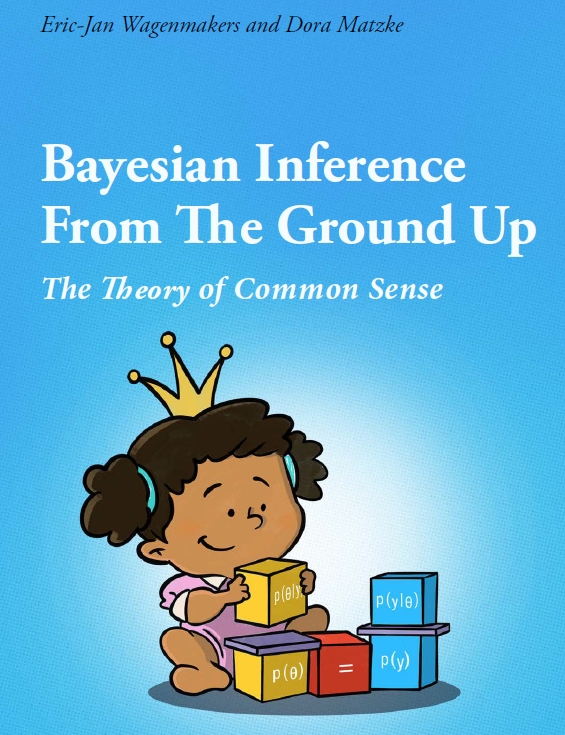
Bayesian inference from the ground up [no book review]
Posted in Books, Kids, Statistics, University life with tags Archimedes death ray, Bayes theorem, Bayesian Inference for Psychological Science, Bayesian inference from the ground up, Bayesian textbook, Bayesian Thinking for Toddlers, book cover, Buffon's needle, E.J. Wagenmakers, French history, Jardin des Plantes, not a book review, Paris, University of Amsterdam on November 7, 2023 by xi'an
an introduction to MCMC sampling
Posted in Books, Kids, Statistics with tags Bayes theorem, cross validated, Gibbs sampling, introduction, MCMC, Metropolis-Hastings algorithm, posterior distribution, Psychonomic Bulletin & Review, psychonomics, review on August 9, 2022 by xi'an Following a rather clueless question on X validated, I had a quick read of A simple introduction to Markov Chain Monte–Carlo sampling, by Ravenzwaaij, Cassey, and Brown, published in 2018 in Psychonomic Bulletin & Review, which I had never opened to this day. The setting is very basic and the authors at pain to make their explanations as simple as possible, but I find the effort somehow backfires under the excess of details. And the characteristic avoidance of mathematical symbols and formulae. For instance, in the Normal mean example that is used as introductory illustration and that confused the question originator, there is no explanation for the posterior being a N(100,15) distribution, 100 being the sample average, the notation N(μ|x,σ) is used for the posterior density, and then the Metropolis comparison brings an added layer of confusion:
“Since the target distribution is normal with mean 100 (the value of the single observation) and standard deviation 15, this means comparing N(100|108, 15) against N(100|110, 15).”
as it most unfortunately exchanges the positions of μ and x (which is equal to 100). There is no fundamental error there, due to the symmetry of the Normal density, but this switch from posterior to likelihood certainly contributes to the confusion of the QO. Similarly for the Metropolis step description:
“If the new proposal has a lower posterior value than the most recent sample, then randomly choose to accept or
reject the new proposal, with a probability equal to the height of both posterior values. “
And the shortcomings of MCMC may prove equally difficult to ingest: like
“The method will “work” (i.e., the sampling distribution will truly be the target distribution) as long as certain conditions are met.
Firstly, the likelihood values calculated (…) to accept or reject the new proposal must accurately reflect the density of the proposal in the target distribution. When MCMC is applied to Bayesian inference, this means that the values calculated must be posterior likelihoods, or at least be proportional to the posterior likelihood (i.e., the ratio of the likelihoods calculated relative to one another must be correct).”
which leaves me uncertain as to what the authors do mean by the alternative situation, i.e., by the proposed value not reflecting the proposal density. Again, the reluctance in using (more) formulae hurts the intended pedagogical explanations.
baseless!
Posted in Books, Statistics with tags 1922, Bayes theorem, epistemic probability, frequency properties, George Boole, history of statistics, inverse probability, normalised maximum likelihood, Pierre Simon Laplace, R.A. Fisher, Siméon Poisson on July 13, 2021 by xi'an
Bayesian basics in Le Monde
Posted in Statistics with tags Bayes theorem, causality, COVID-19, False positive, Le Monde, medical statistics, pandemic on September 12, 2020 by xi'an
Bayes plaque
Posted in Books, pictures, Statistics, Travel, University life with tags Bayes theorem, Edinburgh, FRS, plaque, Royal Society, Scotland, Thomas Bayes, University of Edinburgh on November 22, 2019 by xi'an


 Xi'an's Og